PART 5: THE DOCUMENT HAROLD SIGNED
I did not run at first.
Fear does strange things to an old body.
It can make the floor seem farther away.
It can make a hallway stretch longer than it has any right to be.
It can make one heartbeat feel like a locked room.
Then my granddaughter screamed again.
That broke whatever froze inside me.
I grabbed the phone, pushed myself out of the chair, and moved toward the stairs while my grandson pounded on the porch door behind me.
“Grandma!” he shouted. “Stay inside!”
But I was already halfway up the stairs.
My knees ached.
My hand shook against the railing.
The house, my beautiful quiet house, was suddenly full of sounds it had never made before.
A door slamming.
Feet running.
My granddaughter sobbing.
My grandson yelling into his phone.
And outside, somewhere beyond the windows, gravel crunching beneath someone who had no business being in my yard.
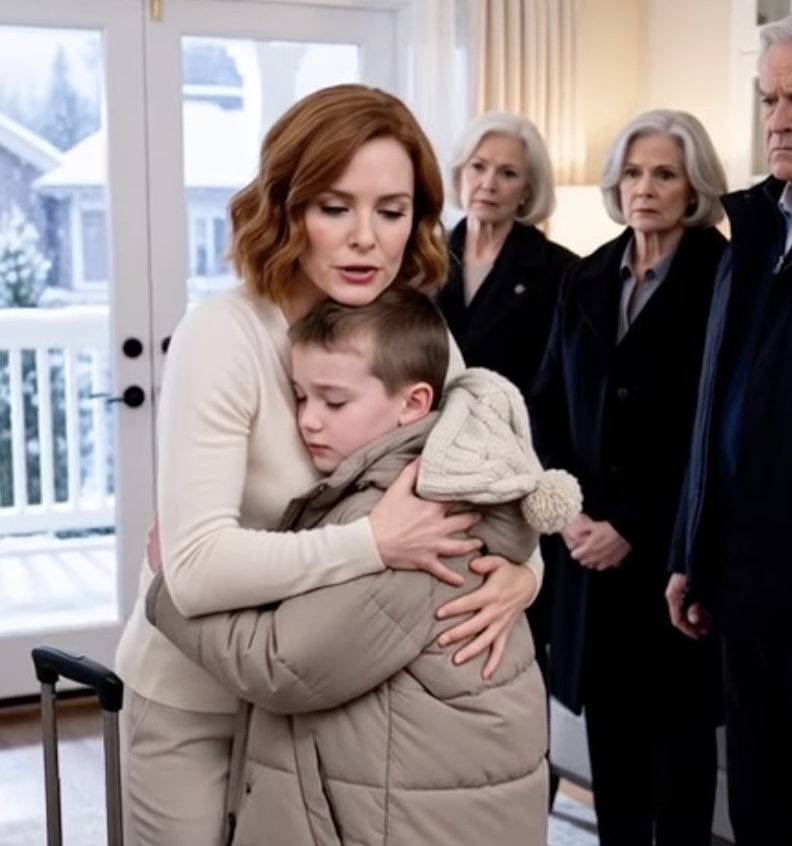
I reached the upstairs hallway and found my granddaughter standing outside the guest room, barefoot, trembling so hard her pajama sleeve had slipped off one shoulder.
“There was a face,” she cried. “At the window.”
The guest room window faced the side yard.
The private side.
The part hidden from the street by two tall oleanders and the old wooden fence.
No neighbor would accidentally walk there.
No delivery driver.
No confused stranger.
I pulled her into my arms.
Her body folded against mine like she was five years old again.
“It’s okay,” I whispered, though it was not okay.
Nothing was okay.
Downstairs, my grandson yelled, “I called 911!”
Then glass broke.
Not upstairs.
Downstairs.
The sharp crash echoed through the house.
My granddaughter screamed into my shoulder.
I turned toward the staircase.
For one sick second, I thought of Renee’s voice.
You have no idea what Daniel signed.
Then I thought of Harold.
Not as he looked in the hospital bed, thin and tired and trying to smile through pain.
I thought of Harold at forty-two, standing in our old kitchen with flour on his shirt because he had tried to make biscuits and nearly destroyed the oven.
I thought of him at sixty-five, holding my hand across a doctor’s desk when they said the word tumor.
I thought of him at seventy-four, whispering, “Don’t let anyone put you away just because I’m gone.”
My breath stopped.
I had forgotten that sentence.
Or maybe I had buried it because remembering would have meant admitting Harold had been afraid before I was.
Downstairs, my grandson shouted, “Get out! The police are coming!”
A man’s voice answered.
Low.
Angry.
Not Daniel.
Not anyone I knew.
“Where is the lockbox?”
The words hit me harder than the glass.
The lockbox.
Harold’s lockbox.
The one Officer Keene had asked about.
The one I had brought from storage but never opened because it still smelled faintly like Harold’s closet, cedar blocks, and old paper.
The one I had placed in the sunroom cabinet behind extra candles and photo albums.
My granddaughter lifted her head.
“Grandma?”
I pressed my phone into her hand.
“Call Patricia. Put it on speaker. Stay behind me.”
“No.”
“Do it.”
I had never used that tone with her before.
She obeyed.
We came down the stairs together slowly.
I kept one hand on the railing and one hand on the wall, not because I was weak, but because anger needed somewhere to go.
At the bottom of the stairs, the broken glass from the side door glittered across the kitchen tile.
Cold air came through the opening.
A man stood near the sunroom cabinet.
Tall.
Thin.
Wearing a navy jacket and gloves.
My grandson stood several feet away with a fireplace poker in both hands, his face white but determined.
The man turned when he saw me.
He was maybe fifty.
Clean haircut.
Expensive shoes.
The kind of man who looked less like a burglar and more like someone who knew which doors rich people forgot to lock.
His eyes dropped to the phone in my granddaughter’s hand.
Then to me.
“Mrs. Whitaker,” he said.
Not surprised.
Not confused.
He knew my name.
My stomach turned.
“Who are you?”
He smiled without warmth.
“Someone trying to save your family from a very expensive mistake.”
Patricia’s voice suddenly came through the phone.
“Margaret? What is happening?”
The man’s face changed when he heard her.
Just slightly.
But enough.
My granddaughter cried, “There’s a man in the house. He broke in.”
“Get out of the house now,” Patricia said.
The man lifted both hands.
“No one needs to be dramatic.”
My grandson raised the poker.
“You broke the door.”
“I knocked first.”
“You broke the door.”
The man sighed like we were all wasting his time.
Then he looked back at me.
“Where is the lockbox?”
The house went so quiet I could hear the refrigerator humming.
I looked at his gloves.
At his jacket.
At the cabinet.
At the broken glass.
Then I understood something that made my skin go cold.
This was not desperation.
This was not a random threat.
This was a retrieval.
Someone had sent him for a specific thing.
“What is in it?” I asked.
He tilted his head.
“If you knew, you wouldn’t be asking.”
Patricia’s voice cut through the room.
“Sir, identify yourself.”
He looked at the phone.
“Tell Patricia Holloway this does not concern her.”
“It does now,” Patricia said. “And so do you.”
For the first time, his smile slipped.
Police sirens wailed in the distance.
Faint.
Then louder.
The man heard them too.
His eyes moved quickly toward the broken side door.
Then toward the cabinet again.
He was deciding.
I could see it.
Whether he had time.
Whether fear was stronger than whatever he had been promised.
Then my granddaughter whispered, “Martin Voss.”
The man froze.
My grandson turned to her.
“What?”
She pointed at the phone screen still lying on the entry table where Daniel had left it earlier.
Renee’s phone.
The lock screen had lit up again.
Another notification.
Martin Voss: Did you get the box?
The man moved.
My grandson swung the poker.
He did not hit the man.
He hit the side of the cabinet.
Hard.
The sound cracked through the room.
The man flinched backward.
That half second saved us.
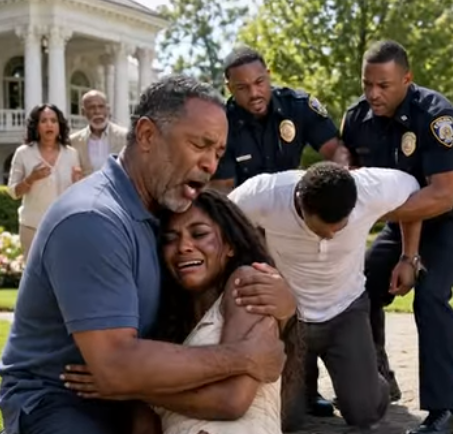
Two police officers came through the front door with Officer Keene behind them, their voices sharp and commanding.
“Hands where we can see them!”
The man lifted his hands slowly.
But his eyes stayed on me.
Not angry.
Not afraid.
Almost amused.
As Officer Keene cuffed him, he said something I will never forget.
“You should have stayed in the guest room.”
My granddaughter burst into tears.
My grandson shouted, “Shut up!”
Officer Keene pulled the man toward the front door.
Patricia stayed on speaker, silent now, listening to every word.
I stood in the middle of my kitchen with broken glass at my feet and realized Renee had not just wanted my money.
She had wanted me small again.
Afraid again.
A guest in my own life again.
And maybe, if that document existed, she had almost succeeded.
After the police took Martin Voss outside, Officer Keene came back in and told us not to touch anything until the scene was photographed.
But I could not stop looking at the sunroom cabinet.
The lockbox was still inside.
He had not reached it.
Not yet.
Daniel arrived eleven minutes later.
He pulled into the driveway so fast his tires spit gravel.
He ran inside wearing the same shirt from earlier, his face gray with panic.
“Mom!”
Then he saw the glass.
The officers.
His children.
Renee’s phone on the table.
The cabinet.
And me standing there with a calm that did not belong to fear anymore.
It belonged to the moment after fear has done its worst and found you still standing.
Daniel reached for his daughter first.
She stepped back.
The movement was small.
But it destroyed him.
He turned to my grandson.
“Are you okay?”
My grandson did not answer.
Then Daniel looked at me.
“Mom, I didn’t know.”
I almost laughed.
Those four words had become his inheritance.
I didn’t know Renee said that.
I didn’t know she took the letter.
I didn’t know she called Patricia.
I didn’t know she hired Martin.
I didn’t know.
A man can hide a whole marriage inside those words if nobody makes him open the door.
Officer Keene approached him.
“Mr. Briggs, we need to ask you some questions.”
Daniel nodded, dazed.
Then Patricia’s voice came through my granddaughter’s phone.
“Before anyone opens that lockbox, I want it documented, photographed, and witnessed.”
Daniel’s head snapped toward the phone.
“The lockbox?”
I watched his face.
Carefully.
This time, there was recognition.
Not confusion.
Recognition.
I felt the last soft place in me harden.
“You know about it,” I said.
Daniel closed his eyes.
“Mom—”
“What did Harold sign?”
He looked at the police officers.
Then at his children.
Then at me.
His mouth opened.
Nothing came out.
Officer Keene’s gaze sharpened.
“Mr. Briggs?”
Daniel sat down slowly at the kitchen table like his legs could no longer hold whatever truth Renee had thrown at us.
“I didn’t understand it at the time,” he whispered.
“When?” I asked.
His eyes filled.
“Before Dad died.”
The room blurred at the edges.
My hand found the back of a chair.
“Tell me.”
Daniel shook his head.
“I was at the hospital one night. Renee had gone home. You were asleep in the recliner beside Dad’s bed. He woke up and asked me to call a notary.”
I stared at him.
“You never told me.”
“He asked me not to until after.”
“After what?”
Daniel’s lips trembled.
“After you were safe.”
Safe.
That word opened something old.
Something I had packed away with Harold’s sweaters and our wedding album.
Daniel looked toward the sunroom cabinet.
“He said there were things in the lockbox. Documents. Recordings. A letter for you. He said if anything happened after he died… if anyone tried to pressure you, move you, take control of your decisions… I was supposed to give it to you.”
My voice came out almost too quiet to hear.
“Then why didn’t you?”
Daniel bent forward, both hands over his face.
“Because Renee found out.”
Nobody spoke.
Even the officers seemed to understand that the law had entered a family wound and was now standing there awkwardly, holding a flashlight.
“She said Dad was confused,” Daniel continued. “She said grief makes people paranoid. She said if I gave you papers right after the funeral, it would break you. And then you sold the house, and you moved in with us, and everything was happening so fast…”
“Fast?” I repeated.
My voice sharpened.
“Two years, Daniel. You had two years.”
He flinched.
“Yes.”
The single word was small.
But at least it was not an excuse.
Officer Keene asked, “Where is this document now?”
Daniel looked at me.
“In the lockbox.”
Patricia spoke immediately.
“Officer, please secure the box as potential evidence. Margaret, do not open it alone.”
I wanted to obey.
I wanted to be sensible.
I wanted to let professionals handle the mystery of my own husband’s final warning.
But there are moments when a woman who has been lied to long enough no longer asks permission to know the truth.
I walked to the sunroom cabinet.
Officer Keene moved with me but did not stop me.
Inside, behind the candles, beneath a folded quilt, was the metal box.
Gray.
Scratched.
Heavier than I remembered.
Harold’s initials were still taped to the top in his crooked handwriting.
H.W.
My fingers shook when I touched it.
Not from fear this time.
From love.
Because suddenly Harold was not just dead.
He was reaching forward.
Across illness.
Across silence.
Across all the rooms where I had been taught to shrink.
Trying, somehow, to put one last key in my hand.
“Mom,” Daniel said behind me.
I turned.
He was crying openly now.
“I’m sorry.”
I looked at him for a long time.
Then I said the truth.
“I believe you.”
Relief flashed across his face.
Too soon.
“I believe you’re sorry,” I continued. “I don’t yet believe you are brave.”
His face collapsed.
Good.
Let that one hurt too.
Officer Keene placed the lockbox on the kitchen table.
“Do you have the key?”
I looked toward my bedroom.
Then stopped.
Harold had always kept the key in the same place.
Taped beneath the bottom drawer of his nightstand.
I had moved that nightstand into my new bedroom because I could not bear the thought of a stranger using it.
I went upstairs slowly.
My granddaughter came with me.
At the bedroom doorway, she touched my arm.
“Grandma,” she whispered, “what if it’s bad?”
I opened the drawer.
Inside were tissues, an old handkerchief, a paperback Harold had never finished, and the small flashlight he kept for power outages.
I pulled the drawer all the way out.
There, taped beneath it, was a tiny brass key.
I held it in my palm.
“It already is bad,” I said softly. “Now we find out how honest bad is willing to be.”
Downstairs, everyone watched as I inserted the key.
It turned with a small, dry click.
The lid opened.
Inside were three things.
A sealed envelope with my name on it.
A flash drive wrapped in masking tape.
And a legal document folded into thirds, notarized six weeks before Harold died.
The room went silent.
I picked up the envelope first.
My name was written in Harold’s hand.
Maggie.
Nobody called me that anymore.
My throat closed.
I opened it carefully.
The letter was only one page.
But the first line nearly brought me to my knees.
My love, if you are reading this, it means they tried to make you believe you were helpless.
I covered my mouth.
Daniel began to sob.
I kept reading.
You are not helpless. You were never helpless. I have watched Daniel become weak where he should have been kind, and I have watched Renee measure you like property she might someday manage. I did not tell you because I was afraid my last days would be stolen by fighting. Forgive me for that cowardice.
My hands shook so badly Patricia asked if someone else should read.
“No,” I said.
I needed Harold’s words in my own voice.
I signed a statement with witnesses. I recorded conversations. I documented what I heard when Renee thought I was asleep. If she ever moves you into that house, if she ever pressures you to sell ours, if she ever speaks of care while arranging control, open this box.
I stopped.
The kitchen disappeared.
The sunroom.
The officers.
The children.
Daniel.
All of it blurred behind the image of Harold lying in a hospital bed, pretending to sleep while people planned around the woman he loved.
I read the last lines.
The trust I created before my death was small, but it was yours. Daniel knows. He was instructed to deliver the documents after the funeral. If he did not, then my fear was right, and your first protection must be from the people closest to you.
Beneath that was one more sentence.
One that changed everything.
Renee is not the only person involved.
The phone on the table buzzed.
Renee’s phone.
Everyone turned.
A new message appeared on the lock screen.
This time, it was not from Martin Voss.
It was from a saved contact named D. Briggs.
Daniel’s face went white.
Because the message had been sent from his number.
And it said:
Did she open Harold’s box yet?