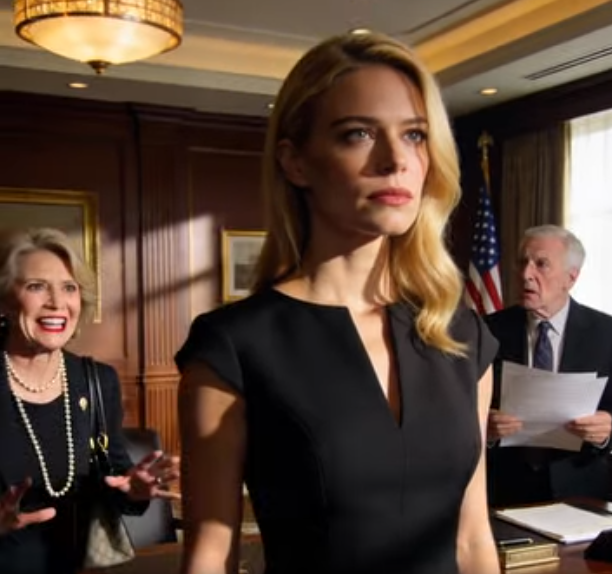
The silence that descended upon the ballroom was not the polite, expectant hush of a wedding ceremony. It was the suffocating, heavy vacuum that precedes a catastrophic collapse. The general counsel, a man named Arthur who had served my father with sycophantic loyalty for two decades, walked past me without making eye contact. His face was ash-gray, his hands trembling as he approached the podium where my father stood.
Vanessa’s smirk wavered, then vanished, replaced by a twitch of predatory anxiety. She reached for my father’s arm, but he was no longer looking at her. His eyes were locked on the thick, embossed leather folder in Arthur’s hands.
The Shattering of the Facade
“Arthur,” my father said, his voice dropping to a gravelly rasp. “What is the meaning of this? This is a private event. The board meeting is upstairs.”
Arthur didn’t answer. He simply opened the folder on the podium, effectively silencing the murmurs of the confused guests. He leaned into the microphone, his voice amplified, echoing off the gilded ceilings. “Ladies and gentlemen, distinguished guests… as General Counsel for Sterling Industries, it is my professional obligation to disclose that the merger agreement currently being signed in the lounge upstairs is based on fraudulent financial reporting.”
The gasp was collective, a sharp intake of breath from three hundred of the city’s most influential people.
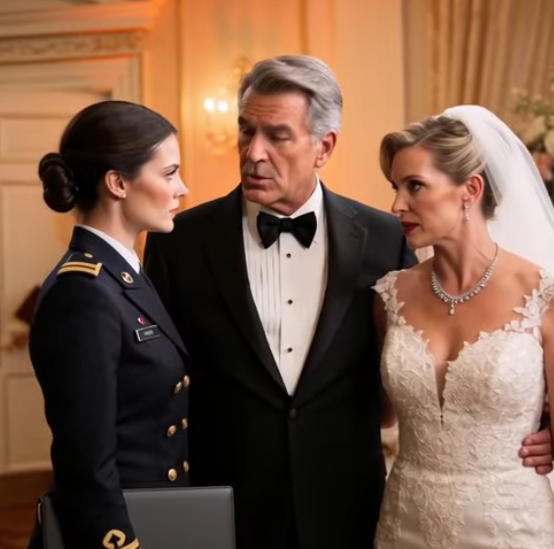
My father lunged for the microphone, his face purple with rage, but I was already moving. I didn’t rush. I walked with the deliberate, agonizingly slow pace of someone who had spent years preparing for this exact moment. I reached the podium just as the security team began to scramble toward us.
“Don’t touch me,” I said, my voice cutting through the rising panic like a razor blade. I looked my father dead in the eye. “The board members aren’t just here for a wedding, Dad. They’re here because they wanted to see the ‘housekeeper’ get kicked out. But they’re about to see their stock options turn into confetti.”
The Anatomy of a Betrayal
The documents Arthur revealed were not just accounting errors. They were the blueprints of a ghost company my father had created—a shell corporation used to siphon off the R&D funds I had generated with my own blood, sweat, and patents during the years he sidelined me. He had used my mother’s inheritance, which he had legally controlled since her death, to bail out his failing vanity projects, all while labeling me ‘unstable’ to ensure I never gained a seat on the board.
I took the microphone from Arthur’s paralyzed hand.
“Five years ago,” I began, my voice steady, amplified, and cold, “I presented a plan to diversify our tech portfolio. My father rejected it, claiming it was ‘too risky.’ Three months later, he fired me, citing ‘performance issues.’ Yet, somehow, the exact technology I designed has been the primary revenue driver for the company for the last forty-eight months.”
I turned to the room, where silence had become an absolute law. “You all know who I am. You know that I founded the division that makes this company worth billions. But you also know that for five years, my father has told you I was an erratic, ungrateful daughter who needed to be kept away from the boardroom for the sake of the shareholders.”
I pulled a small USB drive from my pocket and held it up. “On this drive is the digital signature trail for every fraudulent transfer. It shows that my father wasn’t just managing the company—he was looting it to fund a lifestyle that Vanessa here is currently wearing in the form of a three-million-dollar diamond necklace.”
Vanessa gasped, clutching her throat, her face turning a sickly, mottled white. The wedding guests, who had spent the last hour whispering insults about my shoes and my status, were now staring at her jewels as if they were evidence in a crime scene.
The Boardroom Coup
The three board members I had seen earlier emerged from the side lounge, their faces unreadable. One of them, a woman named Eleanor who had once told me I ‘didn’t have the stomach for the industry,’ walked toward the podium. She didn’t look at my father. She looked at me.
“Claire,” Eleanor said, her voice sharp. “We were told these files were purged. We were told you stole them.”
“I didn’t steal what was mine to begin with, Eleanor,” I replied. “I archived what you were too lazy to audit.”
My father regained his composure, his voice dropping into the smooth, practiced tone of a manipulator. “This is a domestic dispute! She’s mentally unstable, fueled by jealousy over my marriage! Security, remove her!”
But the security guards remained frozen. They had seen the documents Arthur was displaying on the giant projection screen behind us—the signatures, the offshore account numbers, the blatant theft. Even they knew a sinking ship when they saw one.
“It’s not a dispute, Dad,” I said, turning back to him. “It’s a liquidation. I’ve already filed a derivative suit on behalf of the shareholders. And since I hold the majority of the minority voting shares—which you conveniently forgot to strip from me during the last restructuring—I have just triggered a vote of no confidence.”
The room erupted. It wasn’t the cheers of a wedding; it was the feral noise of a pack of wolves realizing the leader was wounded. The business elite in the room—lawyers, investors, partners—were already pulling out their phones, making calls, distancing themselves from the Sterling brand.
The Price of a Legacy
The next six months were a blur of depositions, injunctions, and the slow, agonizing dismantling of my father’s empire. I didn’t take pleasure in it, not in the way he thought I would. It wasn’t a victory of ego; it was an act of sanitation. I was cleaning out a house that had been rotting from the inside out for years.
My father didn’t go to prison, but he lost everything else. His mansion, his yacht, his reputation—all sacrificed to pay back the investors he had defrauded. Vanessa left him three days after the ‘wedding’ was officially annulled, taking the diamond necklace with her, only to find out it was a cubic zirconia replica—my father had been leveraging his assets so hard he couldn’t even afford the real thing for his third wife.
I found him at a small, dingy diner on the outskirts of the city a year later. He was older, broken, and looked like the shell of the titan I once feared. He didn’t recognize me at first. When he did, he didn’t reach for my hand. He didn’t ask for forgiveness. He just looked down at his black coffee.
“You won,” he whispered.
“I didn’t win,” I corrected him. “I survived.”
“You always were too smart for your own good,” he said, a ghost of his old arrogance flickering in his eyes. “You could have had it all, Claire. You could have been the queen of this industry.”
“I didn’t want to be a queen,” I said, standing up to leave. “I just wanted to be the architect of my own life. You were the only one who didn’t let that happen.”
The New Dawn
I walked out of the diner and into the cool autumn air. The corporate landscape was changing. Under my leadership, Sterling Industries—now rebranded as Aethelgard Tech—had pivoted toward sustainable infrastructure. I had fired the sycophants, hired the brilliant minds that my father had mocked, and built a culture rooted in transparency rather than terror.
I drove back to my office, a space I had designed myself. It had no service corridors. Everyone entered through the front doors.
As I sat at my desk, looking out over the city skyline, I opened the black folder I had carried that day at the wedding. It was empty now, its contents shredded and recycled. I realized then that the humiliation I had suffered—the insults, the ‘housekeeper’ comments, the erasure—was the catalyst I needed. It had forced me to build a strength that no board vote could take away.
I had come to the wedding to save my father from his own greed, hoping, perhaps, for a moment of reconciliation. But he had been too blinded by his own narcissism to see the fire he was walking into. I realized that the greatest power wasn’t in punishing him; it was in the fact that his actions no longer defined my trajectory.
The board meeting was scheduled for ten the next morning. My assistant knocked on the door. “They’re ready for you, Ms. Sterling.”
I stood up, adjusted my blazer, and smiled. I wasn’t an outsider anymore. I wasn’t the housekeeper. I was the one holding the keys to the future. I walked out of my office, not with the weight of my father’s legacy on my shoulders, but with the lightness of a woman who had finally rewritten her own story.
The game had been played, the pieces had been swept off the board, and the game was mine to dictate. As I entered the boardroom, I didn’t see enemies. I saw a future I had built from the ashes of a lie, and for the first time in my life, the view was absolutely, breathlessly perfect