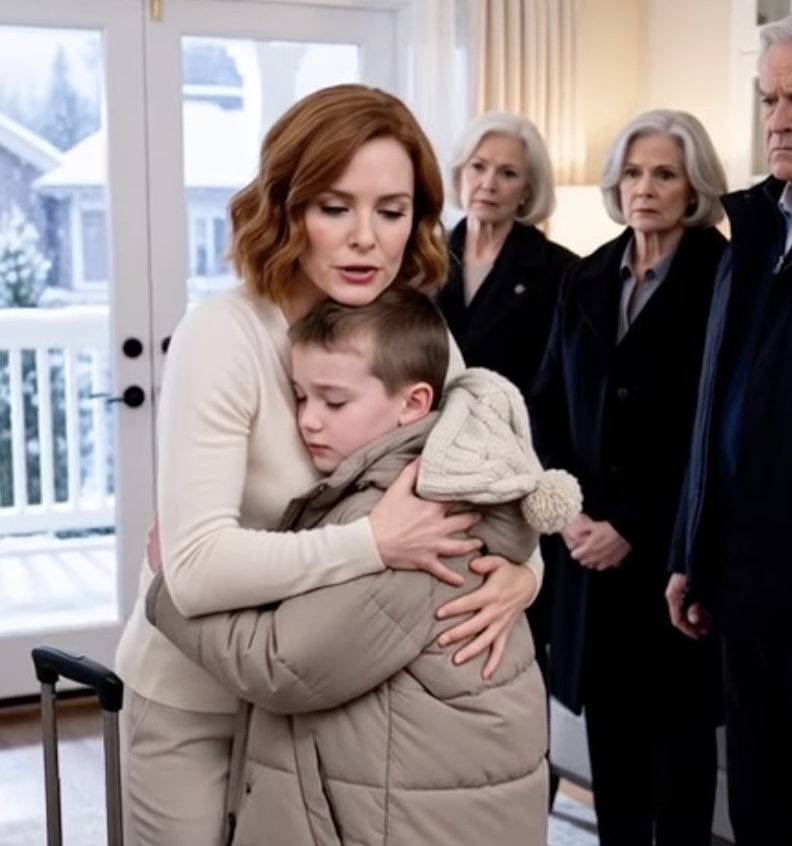
I tried to swallow, to make my lips work, to call out to Ryan, but my body refused. The numbness in my mouth wasn’t from fear. It was chemical. Whatever Ethan had put in the chicken was still coursing through my veins. My vision blurred slightly at the edges, but I forced my eyes back to the kitchen.
Ethan’s phone buzzed again. He answered without looking at the screen, his voice low, sharp, full of calculation. “Yes… yes, everything went according to plan.” He smiled briefly, but not at me, not at Ryan. The smile was for the woman on the other end. The one orchestrating this, guiding him.
I realized I had minutes, maybe seconds, before Ryan could be affected further. Crawling felt impossible at first, but sheer panic pushed me forward. I dragged myself across the hardwood, the taste of bile rising as the green sauce made its cruel work. I reached Ryan and shook him gently. “Wake up, baby… please wake up.” His eyelids flickered. He stirred. Not fully alert, but alive.
I pressed the panic button on the wall, then my cell. My hands shook so violently that I almost dropped the phone. 911. “Please… please send someone. My husband… he poisoned us…” I gasped out the words, my throat tight, my voice trembling.
In the living room, Ethan’s shadow paused. He turned slightly, as if sensing movement, but didn’t approach. He only said, “Make it quick.”
I dragged Ryan to the bathroom, locked the door, and held him close. Every second stretched into eternity. The smell of cilantro, lime, and garlic still hung in the air, but it had become a chemical weapon, a silent reminder of his betrayal.
Then my phone buzzed. Unknown number.
“Check the trash. There’s proof. He’s coming back.”
I didn’t need to ask who. I already knew. My stomach dropped, my hands shaking more violently. Ryan’s small body was warm against mine, breathing shallowly. I whispered promises I didn’t know I could keep, stroking his hair, telling him over and over: “We’re safe. We’re safe.”
I pressed my ear to the door. The front door opened. Heavy steps. My heart raced. Whoever was coming had one goal. And I had only one choice: protect my son, survive this night, and keep evidence of their plan.
It was going to be a long night. And nothing in my life had prepared me for the betrayal that was about to return.

My husband kissed our son goodnight after serving us chicken in green sauce, watched Ryan and me collapse onto the kitchen floor, and then whispered into his phone, “It’s done… soon they’ll both be gone,” while I lay there pretending to be unconscious and listening to the woman on the other end tell him they were finally free. I waited until he dragged a bag across the floor and walked out, crawled to lock myself in the bathroom with my half-conscious child, and called 911 with shaking hands—only for an unknown number to text me, “Check the trash. There’s proof. He’s coming back,” and one minute later, I heard my front door open again…
My husband said good night after poisoning my son and me with chicken in green sauce, picked up his phone, and whispered, “It’s done. Soon they’ll both be gone.”
I was lying on the dining room floor with my cheek pressed against the cold hardwood, one arm twisted under my body and my son’s small hand just inches from mine. The room had gone strangely quiet, except for the hum of the refrigerator and the soft clink of a fork settling against a plate. The house smelled like comfort: cilantro, garlic, warm spices, roasted chicken, fresh lime. It smelled like the kind of meal a man makes when he wants to apologize, the kind of meal that says let’s start over, the kind of meal I had spent years hoping Ethan would make because he meant it.
But beneath the herbs and butter and heat, something rotten had been hiding.
I did not breathe the way a living person breathes.
I let my body stay loose and heavy, let my eyelids remain half closed, let my mouth fall slightly open as though consciousness had left me completely. I could feel my heart hammering in my throat, but I prayed it was not visible. I prayed my husband could not see the pulse beating under my skin. I prayed Ryan, my eight-year-old son, understood enough not to call out for me.
Ethan’s polished black shoes came into view.
He stood over me for a moment. Not rushing. Not panicked. Not horrified. Just looking. A husband who finds his wife collapsed at the dinner table should shout. He should drop to his knees. He should call 911 with shaking hands. He should gather his child in his arms and beg God, or the operator, or anyone listening, to save them.
Ethan did none of those things.
He nudged my ankle with the toe of his shoe.
That one word entered me like ice.
The man I had married nine years earlier, the man who had held Ryan at three years old and promised to love him as his own, the man who still signed birthday cards Dad even after the warmth had faded from his eyes, stood over our bodies and sounded satisfied.
I heard him walk away. His footsteps moved from the dining room into the kitchen, precise and unhurried. The faucet turned on. Water ran for a few seconds. A cabinet opened. A drawer slid shut. Somewhere nearby, Ryan made the smallest sound, a thin breath caught behind his teeth.
Don’t move, baby, I thought. Please don’t move.
The weakness in my limbs was terrifying. Whatever Ethan had put in the food had made my body feel distant from me, as if I were trying to operate it from another room. My tongue was thick. My chest felt weighted. My fingers tingled against the floor. Darkness kept pressing at the edges of my vision, tempting me to fall fully into it, promising rest, promising escape.
A mother’s body can become a locked door when her child is on the other side.
I heard Ethan’s phone unlock. Then his voice, lower now, intimate in a way I had not heard in months.
“They took it,” he whispered. “Both of them.”
A woman answered. I could not make out the first sentence, only the shape of her voice through the speaker, sharp with nerves and excitement.
Ethan said, “No, I measured it. It’ll look accidental.”
Then the woman said clearly, “Are you sure about the boy?”
Not Ryan. Not your son. Not that sweet child who still left drawings on the refrigerator and slept with one sock on because he said his right foot got colder than his left.
Ethan’s reply was quiet enough that I almost missed it.
“He had to go too. If she dies and he lives, everything gets complicated.”
I stared at a scratch in the floorboards inches from my face. I knew that scratch. Ryan had made it two years earlier dragging a chair across the room to hang a paper bat from the chandelier for Halloween. I had scolded him for it, then laughed when he insisted the bat needed height for dramatic effect. Ethan had not laughed. He had said children should learn to respect property.
To Ethan, even Ryan had become property. An obstacle. A complication.
The woman breathed out. “Finally,” she said. “Finally, we’re free.”
Ethan gave a soft laugh, almost tender. “I’ve been waiting for this.”
Betrayal does not always arrive as a scream. Sometimes it sits across from you at dinner, refills your water glass, reminds your child to use a napkin, and waits for your breathing to slow.
The evening had begun like something from a memory I would have wanted to keep.
Ethan came home early, which should have been my first warning. For the last year, he had rarely come home before seven-thirty, and when he did, he brought the office with him: phone in hand, Bluetooth in one ear, jaw clenched around numbers I was no longer allowed to ask about. He worked in commercial insurance, or at least that was how he described it when neighbors asked. In reality, he ran risk assessments for wealthy clients, corporations, and families who wanted to make sure catastrophe paid properly if it ever arrived. He understood policies, beneficiaries, liability, exclusions, signatures, and the frighteningly thin line between tragedy and payout.
That night, he came through the front door at five-fifteen carrying two grocery bags.
Ryan looked up from the living room rug, where he was building a Lego spaceship with a concentration so fierce his tongue stuck out slightly. “Dad? You’re home before the sun went away.”
Ethan smiled. “Miracles happen.”
I stood in the hallway holding a basket of laundry, watching him. He looked handsome in the careful way he always looked handsome: dark hair combed back, sleeves rolled just enough to seem relaxed, wedding ring catching the light. But there was something too smooth about him. His face had the calm of a man performing calm.
“What’s all this?” I asked.
“Dinner,” he said. “I thought I’d cook.”
Ryan laughed. “Dad cooks toast.”
“I can do more than toast,” Ethan said, setting the bags on the counter. “Your mother has simply never given me the opportunity to prove it.”
That was not true. I had given Ethan countless opportunities to be many things. Present. Kind. Honest. Gentle. Sorry. He had declined most of them.
Still, something in me wanted to believe the gesture. That was the humiliating thing about hope. It could survive almost any evidence against it. For weeks, Ethan had been different, not warmer exactly, but attentive in a new and unsettling way. He had asked when Ryan’s school conferences were. He had fixed the loose cabinet hinge without being asked. He had offered to review our life insurance policies “for planning purposes.” He had brought home flowers once, grocery-store tulips still in plastic, and placed them in a vase without comment.
At first, I wondered if he was having an affair and trying to cover it with sudden domestic behavior. Then I wondered if he was about to leave and wanted a cleaner conscience. I had not allowed myself to wonder if he was rehearsing grief.
He moved through the kitchen that evening with surprising confidence. He washed cilantro in the colander, chopped onions, seared chicken thighs in the heavy pan my mother had given me when Ryan was born. He played old soul music through the speaker on the counter. He poured apple juice for Ryan in the blue cup with cartoon rockets on it and wine for me in the thin-stemmed glasses we used only when company came.
“Dad looks like a chef today,” Ryan said, climbing into his chair.
“Let’s hope we don’t get charged,” I teased.
Ethan laughed lightly, but the sound did not reach his eyes.
He had set the table with our good napkins. That bothered me more than anything. Ethan had never cared about napkins. He cared about appearances, yes, but not the small domestic rituals that made a meal feel chosen. The napkins were white cotton, folded into neat rectangles beside each plate. The glasses were polished. The candles were lit. Clean linens, polished silverware, warm plates, the whole scene arranged with such care that it felt less like love than staging.
“You didn’t have to do all this,” I said.
I looked at him over the rim of my wineglass. “Why?”
His expression flickered.
“Because you deserve it,” he said.
Once, those words might have undone me. That night, they felt like something memorized.
Ryan ate first because Ryan always ate first. He was in that hungry, growing age where every meal became a negotiation between appetite and distraction. He dragged a piece of chicken through the green sauce, took a bite, and made an approving sound.
Ryan grinned. “No offense.”
I tasted mine. The sauce was bright and sharp, maybe overly seasoned, but not unpleasant. Cilantro, lime, garlic, heat at the back of the tongue. Ethan barely touched his plate. He cut one small piece of chicken, dipped it in the sauce, raised it to his mouth, then set his fork down when his phone buzzed.
“Aren’t you eating?” I asked.
“Too much tasting while cooking.”
Ryan talked about school, about a math game, about a boy named Mason who fell at recess and got a nosebleed that looked “like a crime scene but smaller.” Ethan smiled in the right places. I tried to relax. I tried to tell myself suspicion had made me unfair. Maybe this was simply a man attempting to repair what he had neglected. Maybe I had become so used to disappointment that kindness now looked like danger.