The Tuition of Betrayal: What I Paid for My Husband’s Degree
By the time my husband crossed the stage to receive his medical degree, I genuinely believed the hardest years of our lives were behind us. I thought the endless, bone-weary exhaustion, the aching soles of my feet, and the quiet grief of putting my own dreams on a shelf had all been a down payment on our future.
It was Marcus’s graduation day. The sun was bright, the grass of the university lawn was a manicured, vivid green, and the air hummed with the chatter of proud families. I sat in the middle rows, clutching a program with his name printed in bold, elegant lettering. This was the moment we were supposed to look at each other and silently agree that every single sacrifice had been worth it.
Instead, he handed me a thick manila envelope that ended our marriage before his diploma was even dry.
We met in the anatomy lab during our first year of medical school. The room smelled permanently of formaldehyde and cold steel, a scent that somehow became the backdrop of our early romance. We were both running on three hours of sleep, fueled by cheap coffee and sheer terror.
Our hands collided over the last pair of medium-sized nitrile gloves in the dispenser box.
“I believe those are mine,” Marcus said, his voice raspy from a long night of memorizing cranial nerves.
“I got here first,” I countered, pulling the box slightly closer to my side of the stainless-steel table.
“That’s not how clinical rotation rules work.”
“It is when I’m the one already wearing one of them.”
He laughed—a genuine, deep sound that cut through the clinical gloom of the basement lab. That laugh was the start of everything.
Within a week, we were inseparable. We studied in the quietest corners of the library, quizzing each other on pathology until the sun came up. We walked each other home through the quiet campus streets, sharing cheap takeout and map-making our futures. Marcus wanted internal medicine; he loved the puzzle of a chronic diagnosis, the slow and steady logic of it. I wanted emergency medicine; I craved the adrenaline, the quick-thinking chaos of the ER.
He was my anchor, the steady presence who reminded me to breathe when the pressure got too high. I was his spark, the one who made him laugh when he forgot how to be a human being outside of his textbooks.
We had a plan. We would graduate, match into residency programs in the same city, get married, and build a life of shared purpose.
Then, during our second semester, the floor fell out from under him.
Marcus’s father’s manufacturing business collapsed into a messy, public bankruptcy. Almost overnight, his family’s assets were frozen or dissolved. Then his mother was diagnosed with a rapidly progressing autoimmune disorder. The steady stream of financial support Marcus relied on vanished.
I will never forget the night he sat on the linoleum floor of my tiny apartment, staring at his tuition statement as if it were a physical threat.
“I have to withdraw,” he said, his voice flat, drained of any fight. “I can’t pay for next term. Even with loans, the gap is too wide, and my credit is shot because of the co-sign issues with my dad.”
“We’ll find a way,” I told him, kneeling down beside him.
“With what, Elena?” he asked, looking at me with eyes so hollowed out by fear I barely recognized him. “We don’t have anything.”
I didn’t have an answer that night. But over the next three weeks, as I watched him lose weight and stare blankly at his textbooks, I formulated a plan. It was a crazy, reckless plan born of a love I believed was indestructible.
I decided to leave medical school so he could stay.
When I told him, he was furious. “No,” he snapped, pacing my kitchen. “Absolutely not. I won’t let you throw your life away for me.”
“It’s not throwing it away,” I said, catching his hands to stop his pacing. “It’s a strategic pivot. One doctor in the family is enough for now. I’ll work. I’ll cover the tuition gap and our living expenses. When you’re done, and we’re stable, I’ll go back. We’re a team, Marcus. Your degree is our degree.”
He stopped fighting. He looked at me, his eyes shining with tears, and took my face in both of his hands. “I will spend the rest of my life making this up to you,” he whispered. “I swear it.”
I believed him. I withdrew from the university the following Monday.
My life quickly became a blur of shifts, schedules, and spreadsheet calculations. I took a daytime job managing the front desk of a busy dental practice, navigating insurance claims and angry patients. At night, I worked as a technician at a 24-hour pharmacy, standing on the hard tile floors until my calves burned. On weekends, I picked up remote medical billing work for an urgent care network.
I learned how to survive on four hours of sleep, generic brand groceries, and the fierce, protective hope that I was building something beautiful.
We got married on a rainy Tuesday morning at the county courthouse. I wore a simple white sundress I bought on sale, and Marcus wore his only decent suit. There was no reception, no family in attendance, and no honeymoon. I had a pharmacy shift starting at two o’clock that afternoon. We told ourselves we would have a real wedding later, when we could afford to pause.
We called it discipline, but in reality, we were just postponing joy.
As the years dragged on, Marcus became more absorbed in his clinical rotations. His vocabulary changed; he spoke in the cold, detached acronyms of the hospital. I tried to keep up, but slowly, the distance between his world and mine began to stretch.
I paid for everything. Rent, utilities, his expensive board prep materials, his dry cleaning, the groceries that fueled his 80-hour weeks. On paper, our financial arrangement was a mess. Because of his family’s complex financial downfall, some old family education trusts were tied up in court, and Marcus had applied for emergency need-based institutional grants. The university required strict documentation of household income, but because we were married, my income technically pushed him out of the lowest brackets.

To keep his grants, his family’s lawyer suggested we keep our finances completely separate on paper, routing my contributions to his expenses through private bank transfers and cash. It felt shady, but we were in survival mode. I didn’t ask questions. I just transferred the money.
When Marcus matched into a highly competitive internal medicine residency, he came home, picked me up in his arms, and spun me around our cramped living room until we both fell onto the worn-out sofa laughing.
“We did it,” he gasped, kissing my forehead.
“You did it,” I corrected gently.
“No,” he said, looking deeply into my eyes. “We did. I would be nothing without you, Elena.”
I held onto those words. They were my armor against the quiet ache I felt every time I walked past the hall closet where my old first-year medical textbooks sat in cardboard boxes, slowly gathering dust.
The shift in Marcus was subtle at first.
In the final months before graduation, he became hyper-protective of his phone. He would step out onto the fire escape to take calls, his voice dropped to a low, urgent murmur. Whenever I entered the living room, he would quickly snap his laptop shut.
One evening, while looking for a stapler in his backpack, I found a thick manila folder. On the tab, my name was printed in his neat, blocky handwriting.
“What’s this?” I asked, holding it up as he walked into the room.
He snatched it from my hand with a speed that startled me, quickly zipping it back into his bag. “Just administrative stuff for residency,” he said, his face tight. “Tax paperwork and spousal health insurance setup. Nothing for you to worry about.”
I wanted so badly to believe that we were finally safe that I forced myself to ignore the cold knot forming in my stomach.
On graduation day, I sat in the crowd and cried tears of pure relief. I watched him walk across the stage in his dark green academic regalia, his hood draped over his shoulders, and I thought, We survived. The sacrifice is over.
After the ceremony, the campus lawn was a sea of black gowns and colorful dresses. I found Marcus standing near the edge of the campus gardens. His parents and his sister were standing a few feet behind him.
When I approached, smiling, his mother quickly looked away, refusing to meet my eyes. The knot in my stomach tightened.
“Marcus!” I said, stepping forward to hug him.
He didn’t hug me back. He stood rigid, his arms at his sides. Slowly, he reached into his gown and pulled out the same thick manila envelope I had seen in his backpack weeks before.
He held it out to me.
“What is this?” I laughed, a nervous, fluttering sound. “Is this our residency housing contract?”
“Open it,” he said. His voice was completely devoid of emotion. It was the voice he used when presenting a terminal patient case to an attending physician—detached, clinical, practiced.
I unclasped the envelope and pulled out the document.
Petition for Dissolution of Marriage.
The words blurred. I looked from the legal jargon to his face, waiting for the punchline, waiting for him to tell me this was some horrible, twisted joke. But his eyes were dead.
“Marcus?” I whispered. “What is this?”
“I’m sorry, Elena,” he said, stepping back toward his family. “But this is how it has to be.”
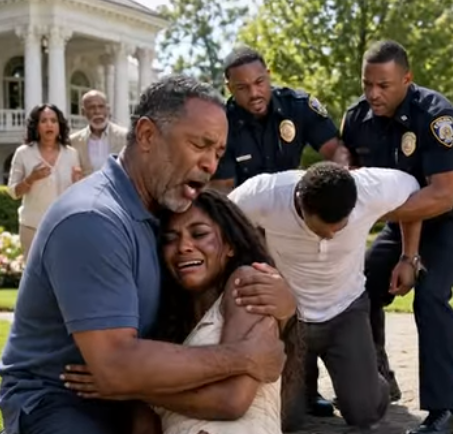
“How it has to be? I worked two jobs! I gave up my career so you could wear that gown!” My voice cracked, rising in pitch, drawing glances from a nearby family taking photos.
“My lawyer will contact you,” he said quietly. Then, without a single backward glance, he turned, joined his parents, and walked toward the parking lot.
I stood frozen on the grass, surrounded by laughter, congratulations, and the popping of champagne corks. I was holding a stack of divorce papers while my husband walked away with a medical degree I had bought for him with my own blood and sweat.
I stumbled toward the edge of the campus, my vision blurred by tears, barely able to breathe. I felt like I was physically dissolving. I had almost reached the campus gates when a hand gently caught my elbow.
I spun around, ready to scream, but stopped when I saw Daniel.
Daniel was one of Marcus’s classmates. He was a quiet, brilliant guy who had always been kind to me at the few school social events I had managed to attend between my work shifts.
“Elena, wait,” Daniel said, his voice urgent. He looked around nervously, checking to see if anyone was watching us.
“Not now, Daniel, please,” I sobbed, trying to pull my arm away. “Marcus just… he just handed me divorce papers. I can’t.”
“I know,” Daniel whispered, his grip tightening just enough to keep me from running. “That’s why you can’t leave yet. You need to know the truth about why he’s doing this.”
I stopped struggling. “What are you talking about?”
Daniel pulled me into the shadow of a large stone archway, away from the flow of graduates. “Two weeks ago, the university’s financial compliance office flagged Marcus’s file. Someone filed an anonymous complaint about his need-based financial aid.”
My heart hammered against my ribs. “What complaint?”
“They started auditing his accounts,” Daniel explained rapidly. “They found the private transfers from your accounts. They realized that while Marcus was claiming zero household income and emergency status to get free tuition and stipends, you were bringing in a steady double-income that was directly paying his living expenses. On paper, it looks like financial fraud.”
I felt the air leave my lungs. “We only did that because his family’s lawyer told us to. We were just trying to get him through school.”
“I believe you,” Daniel said gently. “But the hospital group hosting his residency program found out. They have a strict ethical compliance clause. If Marcus is implicated in financial aid fraud, they will revoke his residency match. His career will be over before it starts.”
“So… he’s divorcing me to protect me from the investigation?” I asked, a tiny, desperate shred of hope flaring up in my chest.
Daniel looked at me with profound pity. “No, Elena. He’s divorcing you to protect himself. His family’s lawyer realized that if you are legally divorced and a settlement is signed before the formal university investigation concludes, Marcus can claim he was entirely unaware of your financial filings. He’s going to blame the discrepancy on you, claiming you handled all the household finances without his knowledge.”
The tiny shred of hope didn’t just die; it turned to ash.
“And there’s more,” Daniel added, looking thoroughly sickened by what he was revealing. “The divorce terms his lawyer drafted—have you read them?”
I looked down at the envelope in my shaking hands. “No.”
“They include a complete waiver of spousal support and a clause releasing him from any financial liabilities or debts incurred during the marriage. If you sign those papers, you waive your right to sue him for tuition reimbursement or the career sacrifices you made. He gets the MD, and you get the blame and the debt.”
“Why are you telling me this, Daniel?” I whispered, my voice trembling.
“Because I watched you work yourself to the bone for him,” Daniel said, his eyes fierce. “We all did. Marcus didn’t get that degree. You did. And I couldn’t watch him ruin your life twice.”
Daniel told me Marcus was staying at a budget motel on Carver Road to keep up the appearance of our immediate separation.
I didn’t go home. I drove straight there.
When I knocked on the door of Room 114, it took a long minute before the lock clicked. Marcus opened it. He had taken off his graduation gown, but he was still wearing his dress shirt and tie, looking disheveled and exhausted.
For a fraction of a second, a look of pure relief washed over his face when he saw me. But it was quickly replaced by a guarded, defensive mask.
“Elena,” he said, stepping back to let me in. “I was going to call you tonight.”
I walked past him, dropping the manila envelope onto the cheap laminate table. “You handed me divorce papers at your graduation, Marcus. You didn’t even have the decency to do it in private.”
“I panicked,” he said, rubbing his face with his hands. “The pressure… you don’t understand.”
“Oh, I think I understand perfectly now,” I said, turning to face him. “Daniel told me about the compliance audit.”
Marcus froze. The color drained from his face. “Daniel has no right to interfere in our personal business.”
“Our business?” I laughed, a bitter, sharp sound. “You made it the university’s business when you committed financial aid fraud and decided to use me as your scapegoat.”
“It’s not like that!” Marcus took a step toward me, his hands raised in appeal. “The lawyer said we needed legal distance immediately. If the university thinks we were colluding to hide assets, they’ll ruin both of us. But if we separate, I can take the hit on the administrative side, and your records stay clean.”
“Stop lying!” I yelled, the anger finally bursting through my grief. “I read the papers, Marcus. Your lawyer drafted a clean exit. No spousal support. No repayment of the tuition I covered. A waiver of all claims. You aren’t trying to protect me. You’re trying to cut me loose so I can’t touch a single dime of your future resident salary, and you’re planning to blame the financial discrepancies on my ‘independent bookkeeping.'”
He didn’t deny it. He couldn’t. He just stood there, looking smaller than I had ever seen him.
This was the man I had given up my life for. I had envisioned him as a savior, a brilliant healer, but under pressure, he was just a coward. When the walls closed in, he didn’t fight for us. He sacrificed me to save himself.
“I loved you,” I said, my voice dropping to a whisper that felt heavier than any shout. “I gave up my white coat so you could have yours. And you treated me like a liability to be managed.”
“I was scared, Elena,” he choked out, tears finally escaping his eyes. “My family… we lost everything once. I couldn’t lose this too. I can’t let my career die.”
“My career died five years ago,” I said, looking at him with a cold clarity that surprised even me. “And I let it happen because I thought your word was a contract. I was wrong.”
I grabbed my purse from the table, leaving the divorce papers behind.
“I won’t be signing those,” I said from the doorway. “You tell your family’s lawyer to prepare for a very different kind of court.”
The next few months were a battlefield, but for the first time in years, I wasn’t fighting tired. I was fighting angry.
With Daniel’s help, I secured a written timeline of the compliance rumors. I hired a relentless family law attorney who specialized in marital asset disputes involving professional degrees. We didn’t just look at our marriage through the lens of love anymore; we looked at it through the cold, hard lens of transactions.
My lawyer compiled every bank transfer, every cash withdrawal, every receipt for his board exams, and every rent check I had signed over the last five years. We presented a mountain of evidence proving that my income had directly subsidized his education, and that the “separate finances” strategy had been orchestrated entirely by his family’s legal counsel, not by me.
Confronted with the paper trail, the university compliance office cleared me of any wrongdoing. Marcus, however, was forced to enter a formal diversion program, agree to repay the disputed institutional grants, and received a formal reprimand on his academic record. His residency program didn’t revoke his match, but he was placed on strict probation.
His golden future was severely tarnished.
Six months after graduation, I sat in my lawyer’s office to sign the final divorce decree. It wasn’t the clean break Marcus had planned. He was legally obligated to pay me a substantial lump-sum settlement representing the reimbursement of his tuition and living expenses, paid out in structured installments over the course of his residency and early attending years.
As I walked out of the office into the cool autumn air, my phone buzzed. It was a text from an admissions officer at the state medical school. My application for readmission had been reviewed, and my clinical credits from my first year had been partially reinstated.
I walked down to the storage locker in the basement of my apartment building. I pulled open the dusty cardboard boxes and took out my old stethoscope, wrapping it around my hand. It felt cold, heavy, and absolutely perfect.
Marcus had his degree, but he would spend the next decade paying for it—both to the bank, and to the conscience he had tried so hard to discard.
I had lost five years, but I had found my way back to the starting line. And this time, I was running the race for myself.