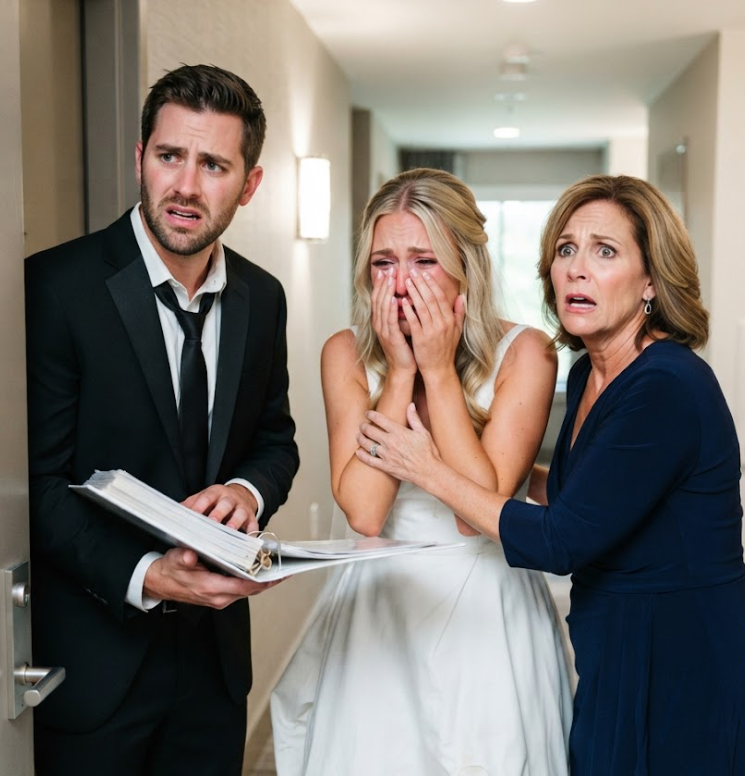
The silence that descended upon the ballroom was not merely a lapse in conversation; it was the heavy, suffocating stillness of a tomb. Six hundred faces, previously animated by the sparkling wine and the spectacle of a million-dollar wedding, now turned toward the doors, their expressions oscillating between confusion, titillation, and a sudden, sharp fear.
Grant, who had been standing with his arm possessively draped over Sloane’s waist, felt the air leave the room. He turned, his face flushed with the lingering remnants of his performative arrogance. He looked at my attorney, Clara, then at the officers, and let out a sound that was half-laugh, half-strangled gasp.
“What is this?” Grant demanded, his voice cracking. “Clara, this is a private event. You are trespassing. Get them out, or I’ll have the police remove you for disturbance of the peace.”
Clara did not blink. She walked past him as if he were merely a decorative pillar, stopping only when she reached the center of the room. She looked at me, a silent question in her eyes, and I gave a singular, imperceptible nod.
“This is not a disturbance, Mr. Whitmore,” Clara said, her voice clear and carrying to the farthest corners of the room. “This is a formal execution of a possessory interest. And you are mistaken regarding the ‘private’ nature of this event. Blackthorn House is currently under a court-ordered administrative freeze. This building, and everything contained within it, is the property of the Whitmore-Halloway Testamentary Trust. A trust for which my client, Eleanor Whitmore, is the sole, controlling trustee.”
The gasp that rippled through the room was audible. Sloane, standing beside him, began to tremble. Her hand, the one holding the mutilated book page, shook violently, causing the paper petals to rustle—a sound like dry leaves in the wind.
“That’s a lie!” Sloane shrieked, her voice thin and desperate. “Grant, tell them! Tell them we own this! You told me—”
“Quiet, Sloane,” I said, my voice cutting through the panic. I stepped away from my table, my heels clicking sharply against the polished marble floor. I moved to the head of the room, past the silver trays and the decadent floral arrangements. I walked right up to the microphone Grant had been using just moments before. I tapped it once, a dull, resonant thump that signaled the end of the performance.
“Grant, you always had a penchant for conflating temporary access with permanent ownership,” I said, keeping my gaze locked on his. “You liked the prestige of Blackthorn House. You liked the way people looked at you when you stood in this ballroom. But you never cared about the history, did you? You treated these books—books that survived two world wars and the migration of my family—like confetti for your vanity. You didn’t just break a marriage, Grant. You broke the covenant of this home.”
Grant’s face was an ashen mask. He looked at the attorneys, then at the crowd, searching for an ally, but he found none. The donors, the senators, the socialites—they were all backing away, creating a wide, empty circle around the couple, as if contagion were airborne.
“Everything here,” I continued, gesturing to the chandeliers, the paintings, and the very walls, “is documented. The archival team behind me has been cataloging the theft since you announced this ‘wedding.’ Not just the books, Grant. The liquid assets you siphoned from the estate accounts to pay for this gala, the forged signatures on the insurance policies, the structural alterations you made without the trust’s authorization.”
I pulled the evidence sleeve from my bag—the one containing the folded page of my grandmother’s book. “Sloane, you asked if it was beautiful. It was. It was a passage about the dignity of belonging to oneself. Now, it is a piece of evidence in a civil suit for the destruction of protected historical property.”
The next few hours were a blur of cold, bureaucratic efficiency. The officers did not come to arrest anyone on the spot, but they were there to oversee the inventory. It was the most satisfying thing I had ever witnessed: the pride of the guests turned into the frantic panic of people realizing they were standing in a crime scene.

Grant tried to argue, his voice rising in volume as he attempted to regain some scrap of control. “I’m a Whitmore!” he shouted, his face contorting. “I’ve lived here for years! You can’t just throw me out on my wedding night!”
“You were a guest of the trust,” I reminded him calmly. “And your welcome expired the moment you decided to monetize my family’s heritage.”
One by one, the guests began to leave. They didn’t linger for cake. They didn’t wait for the band to play another song. They left, clutching their expensive coats, avoiding eye contact with me, afraid that if they stayed, they might be implicated in the disgrace.
By midnight, the house was silent. The staff I had hired—the ones who had been loyal to the estate, not to Grant—began the work of removing the wedding detritus. The pink silk banners were ripped down. The white orchids were cleared.
Grant and Sloane were huddled in the foyer, their luggage sitting in the rain on the stone steps outside. The county officers had given them exactly thirty minutes to vacate the premises.
“You’ll regret this,” Grant hissed, his veneer of sophistication finally shattering into raw, jagged bitterness. “You think you’ve won, but you’re nothing without the image we built. Everyone knows us as the couple at Blackthorn. You’re just the woman who ruined a wedding.”
“I am the woman who saved a legacy,” I replied, standing at the top of the stairs, looking down at him. “And you, Grant, are just a man who forgot that history has a long memory.”
I closed the massive oak doors behind them. The lock clicked—a heavy, final sound that reverberated through the grand entrance.
The weeks that followed were a chaotic storm of litigation, but the outcome was never in doubt. My attorneys were relentless. Grant had been careless; he had left a trail of financial breadcrumbs so wide that even a blind auditor could have followed them.
The “Blackthorn Wedding” became the scandal of the year. The papers feasted on it. The Estate Heist, they called it. Sloane Bell, who had tried so desperately to define herself by her proximity to wealth, was now defined by the court documents detailing her involvement in the destruction of priceless artifacts. Her reputation, so carefully curated through Instagram posts and society columns, evaporated.
I did not celebrate. I did not throw parties. I went to work.
The trust required oversight, and the house required restoration. I spent my days in the library, the very room where my grandmother had sat while writing those notes in the margins. I hired conservationists to assess the damage to the books. Some were beyond repair, but many were saved. I held the pages in my hands—the ones that had been spared from the paper-folding madness—and felt a profound sense of connection to the past.
I learned that Grant had moved into a small, nondescript apartment on the edge of the city. His company had filed for bankruptcy, and the investors he had courted at the wedding had sued him into oblivion. He had tried to reach out to me twice—once with a plea for “closure,” and once with a demand for a settlement. I never read the letters. I simply had my assistant return them, marked Refused.
As for Sloane, she had disappeared from the social scene entirely. I heard rumors she was working a retail job, trying to pay off the legal fees from the destruction of property charges. It wasn’t revenge, I told myself. It was simply the gravitational pull of reality.
Six months later, on the anniversary of the day I had left the marriage, I stood in the ballroom of Blackthorn House.
It was quiet. The marble was polished to a high sheen, reflecting the light of the setting sun. There were no orchids, no champagne, no Senators. It was just me, the history of my family, and a future that felt vast and unencumbered.
I sat at my grandmother’s writing desk, the one she had used to write the very notes that had been so cruelly abused by my ex-husband’s mistress. I opened a new book—a blank ledger—and began to write.
I wasn’t writing about the wedding. I wasn’t writing about the betrayal or the legal battles. I was writing about the restoration. I was writing about the foundation, the scholarships I was starting in my grandmother’s name, and the plans I had to turn the library into a public archive for researchers.
I looked around the room. The house felt lighter. The shadows that had been cast by Grant’s presence had been banished, cleared out by the cold, hard wind of truth.
I realized then that I had been afraid of losing this house for years. I had treated it as a sanctuary, a place to hide from the world, and by doing so, I had allowed Grant to believe he could control it. I had been a guardian, yes, but a passive one.
I was not a guardian anymore. I was an architect.
I stood up and walked to the window, looking out over the sprawling estate. The grounds were green, the trees were ancient, and the house stood firm. It had survived a war, a fire, and the small, petty larceny of a man who thought he could buy his way into a legacy.
My phone buzzed on the desk. A notification from my attorney. “The final settlement is signed, Eleanor. Everything is officially back in the trust. The name on the deed is yours, and yours alone.”
I didn’t smile. I felt something deeper than happiness. I felt whole.
I turned back to the ledger. I had spent so much of my life trying to keep the walls of Blackthorn from crumbling. Now, I understood that the walls were not the house. The house was the spirit of those who built it, the values they stood for, and the integrity of the person currently holding the keys.
I closed the ledger and placed it in the drawer. I went to the fireplace, lit a single log, and watched the flames dance. The past was settled. The books were safe.
I walked toward the door, leaving the ballroom behind, but for the first time in my life, I didn’t feel like I was leaving my home. I was carrying it with me, in the strength of my spine and the clarity of my purpose.
The sun set completely, casting the house into darkness, but I didn’t reach for the lights. I knew every corner of this place, every creak in the floorboards, every whisper in the rafters. I had walked through the fire, and I had come out on the other side, not as a victim of a story, but as the one who was finally writing it.
And as I walked through the halls of Blackthorn House, the air felt fresher, cleaner, and full of the promise of a morning that belonged entirely to me. I was home, and for the first time, I was truly free.