Part 2: I Faked My Paralysis to Test My Fiancée—Her Cruel Reaction Shocked Everyone.
The first time Vanessa called me pathetic, everyone laughed. The second time… I decided to let them. Because I needed to know who they truly were. I sat in the middle of my father’s grand ballroom, covered by a gray blanket, my hands resting quietly on the wheels of my wheelchair. Above me, crystal chandeliers reflected against hundreds of champagne glasses. The room was filled with people who claimed they came to “welcome me home.” Family, friends, business partners—people who had spent years smiling beside me, waiting for the crumbs of my success.
They all believed the same story. They believed the accident had destroyed my life. They believed I would never walk again, and that the man who built a successful tech empire was now powerless. But only a handful of people knew the truth. My bones were never broken. My spine was never damaged. The crash was real; the injury was not. My doctors, my attorney, and my security chief knew the truth. Together, we made one decision: We would let everyone believe I was helpless.
Especially Vanessa. Because before the accident, I thought I knew my fiancée. I thought she loved me. I thought the woman who held my hand during business trips and smiled beside me at charity events cared about the person underneath the wealth. I was wrong. The moment she believed I had lost my power, she revealed everything.
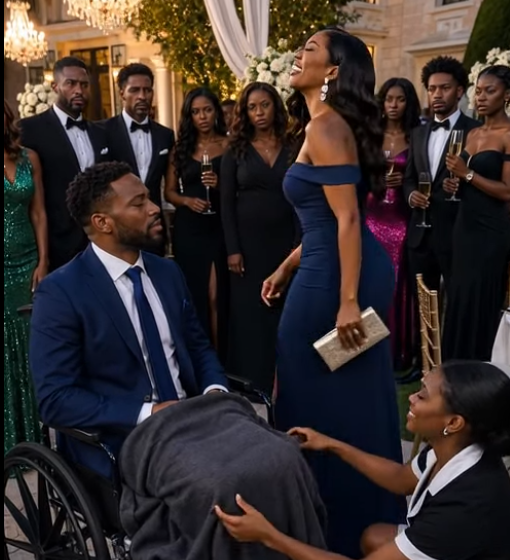
Vanessa entered the ballroom wearing a silver dress. Her diamond engagement ring caught the light with every step—a symbol of the future she thought she was guaranteed. She walked toward me slowly, not like someone visiting the man she loved, but like someone inspecting a broken piece of furniture that had lost its value. Behind her stood my cousins, my business associates—the people who always called me “family”—watching quietly, waiting, curious.
Vanessa leaned closer, her voice soft enough to sound cruel: “Look at you. Now you’re nothing. Just a helpless cripple.” A few people shifted uncomfortably, but then came the laughter. Small at first, then louder. My uncle Martin looked away, and my childhood friend Daniel lowered his head. Nobody defended me. I kept my expression calm, because this was exactly what I needed to see. Vanessa tapped my blanket with her manicured finger. “I was supposed to marry a powerful man. Not a burden.” When I reminded her we were still engaged, she laughed. “For now. Until your board realizes you can’t even walk into a meeting anymore.”
Part 2: The Silent Witness
Then someone moved beside me. Someone nobody expected. Clara, the housemaid who had worked for my family for three years, quietly knelt beside my wheelchair. Without saying a word, she lifted the blanket Vanessa had pushed aside and carefully placed it back over my legs. She leaned closer, her voice barely a whisper: “You still deserve to be treated with kindness.”
Those words hit harder than any insult. They were simple, honest, and real. Vanessa looked down at her and laughed. “How touching. The servant feels sorry for him.” Clara lowered her eyes but didn’t move. She stayed beside me, steady, kind, and brave. In that moment, I remembered everything: the times she brought my medication without being asked, the mornings she checked if I had eaten, the moments when Vanessa spoke to me with fake affection while Clara watched, knowing something was deeply wrong. Clara never cared about my money, my name, or my position. She treated me like a person when everyone else treated me like a broken investment.
I looked at her hand resting gently on the blanket. I finally understood the truth. The accident didn’t break me; it exposed everyone. Vanessa thought the wheelchair was my weakness. She didn’t realize it was the greatest test I had ever given the people around me. And now, I knew exactly who belonged in my future—and who was about to lose everything.
Part 3: The Unmasking
The silence in the grand ballroom grew suffocating. Vanessa’s laughter, sharp and dissonant like breaking glass, still echoed. She stood there, wrapped in her silver armor, convinced she was the protagonist of a tragedy where I was merely the prop. She had no idea she was the antagonist in a story rapidly approaching its final act.
I shifted my weight—a small, subtle movement noticed only by Clara. She looked at me, and I gave her a microscopic nod. “You’re right, Vanessa,” I said, my voice steady. “We do belong together.”
Vanessa scoffed, checking her diamond watch—the one I had bought her for our one-year anniversary. “I’m done with this performance. I have a dinner at the club.” She turned to the crowd, her face morphing into a mask of practiced sorrow. “Thank you all for coming. We’ve all seen how hard this is. I’ll be taking a leave of absence to… manage Arthur’s affairs.”
“I’m afraid that won’t be necessary,” I said. The room froze. I gripped the armrests of the wheelchair and stood up. The sound of the chair’s leather creaking against my back as I rose was the loudest thing I had ever heard. The room erupted into gasps. Vanessa’s jaw dropped so low she looked like a caricature of shock.
I stood at my full height, towering over the guests who had spent the last twenty minutes whispering about my demise. I looked directly at Vanessa. “The accident was real, Vanessa. But the paralysis? That was the greatest performance of my life. And you… you gave the performance of a lifetime.”
“Arthur, wait, I didn’t mean—I was just frustrated, the stress, you don’t understand—”
“I understand perfectly,” I interrupted, stopping inches from her. “You wanted the lifestyle, the title, the power. But you forgot one thing: power isn’t given, Vanessa. It’s earned. And you just spent the last hour demonstrating exactly why you don’t deserve a single cent of it.”
I turned to the room, my gaze sweeping over the faces of my ‘friends.’ Their masks were slipping. The pity was gone, replaced by naked, trembling fear. They knew what I was capable of. “The board meeting scheduled for Monday morning? It’s canceled. In its place, there will be a legal audit of every single contract, every investment, and every ‘charity’ donation made by this family in the last six months.”
Part 4: The Architect of Freedom
I turned back to Clara. I reached down and offered her my hand. She hesitated, then took it, and I pulled her to her feet. “Clara,” I said, loud enough for the entire ballroom to hear. “I believe you were looking for an opportunity to go back to school? Consider yourself the new Head of Operations for the Brooks Foundation. I’ve spent years looking for someone with integrity in this house. It turns out, I only had to look toward the kitchen.”
Vanessa screamed, a high-pitched, jagged sound of pure entitlement. “You can’t do this! You promised me!”
“The engagement is terminated,” I said, signaling to my security chief. “You have ten minutes to collect your things and vacate the premises.” As she was escorted out, her heels clicking angrily against the floor, I felt a weight leave my chest. I spent the next three hours in the study, reviewing files while the party disintegrated. By the time I walked out, the house was silent. My ‘family’ had vanished like smoke.
I walked into the kitchen, a space I had rarely visited. Clara was there, sitting at the small wooden table, a stack of books open. “Mr. Brooks? I—I was just finishing up the final inventory for the staff.”
“Sit down, Clara,” I said. “No more ‘Mr. Brooks.’ It’s Arthur. And we have a lot to discuss about rebuilding.”
“Why did you do it? The test, I mean,” she asked.
“Loyalty isn’t something you can ask for, Clara,” I replied, looking out the window at the sprawling gardens. “It’s something you reveal. I had to become the very thing I feared most—broken—to see who was actually holding the lamp.”
I stepped out onto the terrace. The morning sun was rising over the Connecticut hills. I had lost a fiancée, a handful of relatives, and a false sense of security. But I had gained the truth. I walked down the steps into the garden, leaving the grand house behind me. I didn’t look back. There was nothing there that I needed. The story I had been living was over. The one I was about to write? It was entirely my own.
Clara followed me out, carrying a thermos of coffee and a laptop. We sat on the bench under the old oak tree—the same tree my grandfather had planted when he first arrived in this country with nothing but a suitcase and a dream.
“So,” she said, opening the laptop. “Where do we start?”
“We start by making things right,” I said. “For the people who have been invisible for far too long.”
It was the beginning of a quiet revolution of kindness, merit, and raw truth. The wheelchair sat in the hallway, a relic of a performance that cost me everything and gave me everything in return. It would serve as a permanent reminder: sometimes, the only way to find out where you’re going is to stand up and walk away from everything you thought you knew. I was simply Arthur. And for the first time, that was more than enough.