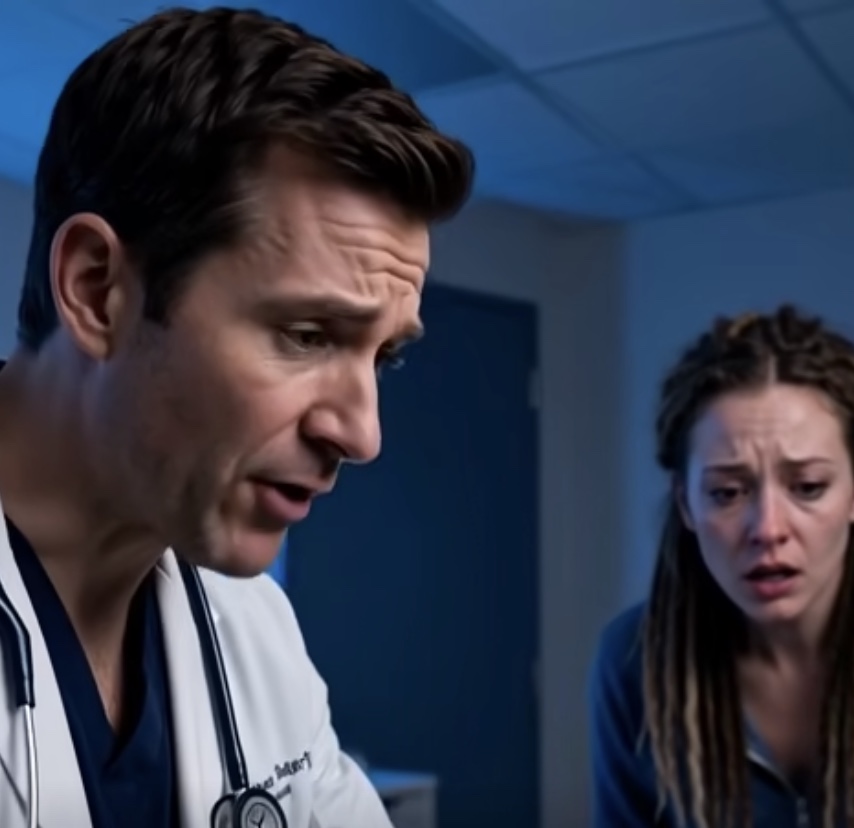
Nathan expected the news of his impending marriage to strike Emily like a physical blow. He watched her intently, his eyes narrow, waiting for the familiar slump of her shoulders or the gloss of tears he had grown accustomed to over the last decade.
Instead, Emily picked up her coffee mug, took a calm, measured sip, and looked at him with an expression that was entirely void of malice. It wasn’t the expression of a woman who had just been discarded; it was the look of a scientist who had just finalized an experiment that had yielded a long-awaited result.
“I hope you’re both very happy, Nathan,” she said.
His mouth opened, then closed. He looked down at the divorce papers as if they had suddenly grown teeth. “You don’t mean that.”
“I do,” Emily replied. “I find I have no space left for bitterness. It’s too heavy, and I have a great deal of packing to do.”
She rose from the stool, her movements fluid and purposeful. For ten years, Emily had moved like a guest in her own home—careful not to leave a fingerprint, careful not to displace the air around Nathan’s ego. Now, she moved with the grounded, heavy-footed confidence of a woman who was already reclaiming her territory.

“I’ll be moving to the guest wing tonight,” she said, already walking toward the hallway. “And I’ll have my lawyers contact yours by Monday morning. I believe you’ll find the settlement process moves much faster once I am no longer interested in your lifestyle.”
“Emily,” Nathan called out, his voice sharp with a sudden, jagged edge of panic. “Don’t do this. Don’t be dramatic.”
She paused at the threshold, looking back at him. The kitchen lighting, which he had always praised for its warmth, now cast his features in a way that made him look like a stranger—a man whose face she had studied for a decade but whose soul she had never truly seen.
“You spent four months planning a new life, Nathan,” she said softly. “I’ve spent the last hour realizing that I’ve been waiting for you to leave me for years. We aren’t being dramatic. We are simply being efficient.”
PART 2 — The Resuscitation
The house went quiet, a silence so profound it felt like the sudden cessation of a long-running, agonizing headache.
In the weeks that followed, Nathan discovered that the divorce was not the neat, quiet administrative task he had envisioned. He had expected Emily to retreat into a rural cottage, weeping over lost anniversaries and playing the role of the humiliated ex-wife.
Instead, he found himself stumbling over the remnants of a woman he had never known.
He came home one evening to find a moving crew clearing out the library. He saw boxes filled with medical textbooks, journals on trauma stabilization, and old research papers that were dated long after he had convinced her to leave medicine.
He picked up a binder. Inside were annotated patient files, surgical notes, and a recommendation letter from a Chief of Medicine that he had never seen before. Dr. Emily Carter is the most promising trauma surgeon I have mentored in twenty years, the letter read. Her intuition is not just a skill; it is a gift.
Nathan felt a cold stone settle in his stomach. He had told her that she was “too emotional” for the ER, that she was “too soft” for the intensity of trauma medicine. He had built his own success on the back of her soft-heartedness, treating her like a decorative accessory while she nurtured his career and managed his life.
He called her number, intending to demand she stop the “performance,” but it went straight to a private voicemail.
He began to track her, not out of love, but out of a desperate, clawing need to understand why he could no longer reach her. He found her at a small, underserved clinic on the outskirts of the city. She wasn’t wearing pearls or designer silk. She was in scrubs, her hair tied back in a messy, practical bun, her face flushed with the exertion of an eighteen-hour shift.
She was stitching a wound for a man who looked like he’d been in a street fight. She didn’t look tired. She looked alive.
When she walked out to the parking lot, Nathan stepped out of his town car, the silver cuff links catching the streetlamp light—the same ones he’d worn the night he asked for the divorce.
“Emily!”
She stopped. She didn’t flinch. She turned slowly, her eyes calm and observant.
“Nathan. You’re trespassing.”
“I saw the books,” he said, his voice straining for control. “I saw the medical records. You lied to me. You told me you wanted to quit.”
“No,” she said. “I told you I loved you. And because I loved you, I allowed you to convince me that I was less than what I was. I lied to myself, Nathan. You were just the catalyst.”
“You’re working in a clinic for people who can’t pay their bills,” he spat, his veneer of dignity finally fracturing. “This is a waste of your brilliance. I could have gotten you a board position at the hospital. I could have made you a Chief.”
“You wanted a wife you could manage,” she said. “You wanted a partner who was an extension of your own reputation. You never wanted a doctor.”
He stepped closer, his face twisted in a way she had only seen when he was arguing a losing case. “Vivian isn’t like you. She doesn’t understand the sacrifice. She wants to be a socialite. She doesn’t have your—your capacity for depth. I made a mistake.”
Emily looked at him, and for the first time, she truly laughed. It wasn’t the laughter of a woman scorned; it was the laughter of a woman who had finally seen the punchline of a very long, very bad joke.
“You think you’re returning a defective product, Nathan. But you’re not. You’re finally realizing that you had the most valuable thing in your life, and you spent ten years trying to break it because you were afraid it might outshine you.”
“Come back,” he whispered, a desperate, pathetic sound. “I can fix this.”
“You can’t fix what you never respected,” she said. She turned her back on him, walking toward her old, rusted sedan. “And for the record, Nathan? Vivian isn’t your ‘first love.’ She’s just the only woman who is as shallow as you are. You deserve each other.”
PART 3 — The Final Diagnosis
Eighteen months later.
The gala at the Metropolitan Museum of Art was the highlight of the social season. Nathan Whitmore moved through the crowd, his smile as practiced as his litigation style. Beside him, Vivian was stunning in a gown that cost more than a mid-sized car, but she was currently arguing with a waiter about the temperature of the champagne.
Nathan felt a hollow ache in his chest—a recurring, phantom pain he had been unable to shake.
Then, the room went still.
A ripple of conversation began to spread through the crowd. Men in expensive suits turned their heads; women in couture looked toward the entrance.
Emily Carter walked into the room.
She wasn’t there as a donor’s wife. She was there as the Keynote Speaker. Last month, she had been appointed the Director of the city’s largest Trauma Response Initiative. She had spent the last year securing millions in private funding, organizing the very clinic she had once worked in, and becoming a leading voice for emergency medical access.
She wore a simple, midnight-blue gown. She had no jewelry, no pretense, just the radiant, terrifying authority of a woman who knew exactly what she was capable of.
She walked past Nathan without pausing.
“Who is that?” Vivian demanded, tugging on his sleeve. “She looks like she owns the place.”
Nathan didn’t answer. He couldn’t. He watched as Emily took the stage.
The room fell into a silence so absolute it made his skin crawl. She spoke about trauma—not the abstract, high-society variety, but the raw, visceral reality of the operating room. She spoke with a clarity and a passion that he had never once heard her use in their ten years of marriage. She was brilliant. She was magnetic. She was everything he had told her she wasn’t.
After the speech, he found her on the terrace, staring out at the city skyline.
“You’re remarkable,” he said, his voice hollow.
Emily didn’t turn around. “I’m exactly who I was before I met you, Nathan. I just stopped letting you define the boundaries of my life.”
“Do you ever think about us?”
“I think about the woman I was,” she said, finally turning to look at him. “I think about how much I had to lose to find myself. But I don’t think about you, Nathan. You’re a closed chapter. A medical footnote. An old injury that has finally finished healing.”
“I’m unhappy, Emily,” he confessed, a crack of honest, desperate humanity leaking through his polished exterior.
Emily tilted her head, her expression one of clinical pity. “That’s the thing about ambition without empathy, Nathan. You’ll always be looking for someone to fill the space you emptied inside yourself. But you’ll never find it in another person.”
She turned and walked back into the warmth of the gala, back into the world she had built with her own two hands.
Nathan stood on the terrace, the cold October wind biting into his skin. He looked at his watch, at his perfectly manicured hands, at the empty space where his life was supposed to be. He realized then that she was right. He hadn’t just lost a wife; he had lost the only witness to his best self, and in his quest to become the most powerful man in the room, he had ensured that he would always be the loneliest.
He remained in the dark, watching the lights of the city pulse like a heartbeat, while somewhere inside, Emily was laughing—really laughing—with a room full of people who finally, truly saw her. The diagnosis was final: Nathan Whitmore was a man who had everything, and yet, he had never been more bankrupt.