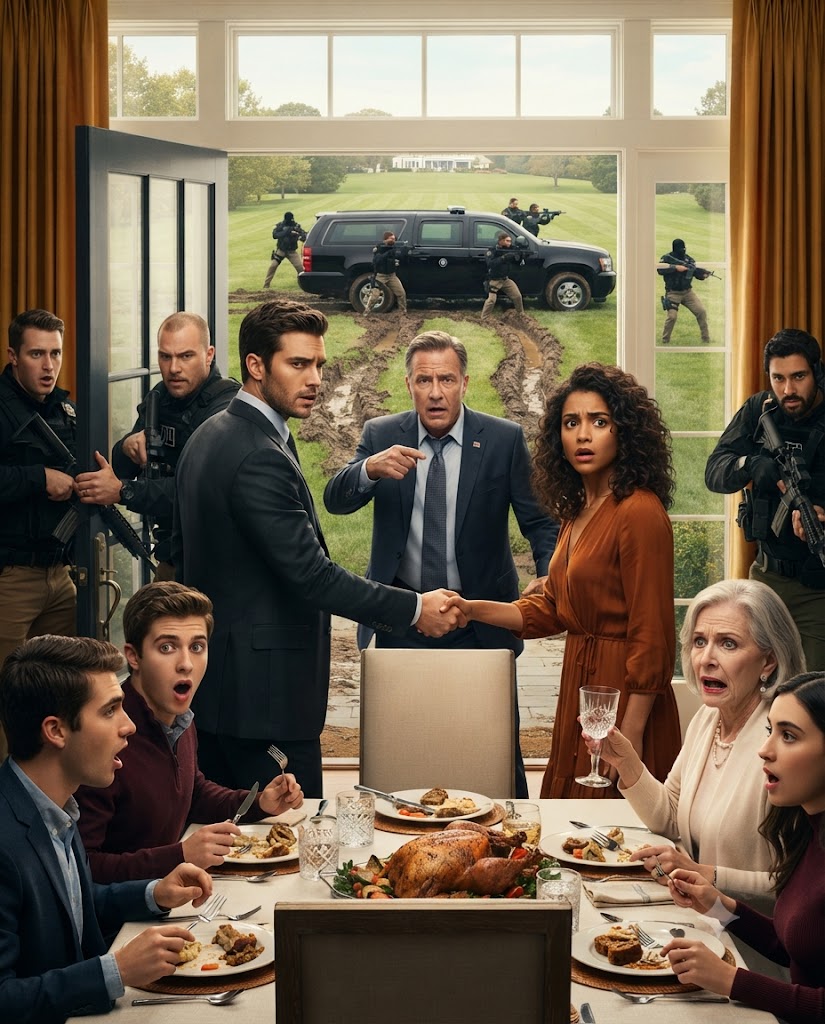
The air in Aunt Clara’s dining room had shifted from the scent of roasted turkey to the metallic tang of fear. The President’s question hung in the air like a guillotine blade, his finger trembling as he pointed at me.
“Is this her?” he repeated, his voice strained, stripped of all executive polish. “James, for the love of God, tell me she’s the one.”
James didn’t look at the President. He kept his eyes locked on mine, his grip on my hand so tight it was bruising. He looked pale—feverish—and there was a darkness under his eyes I had never seen in the months we’d spent together. “She’s the one, sir,” James replied, his voice barely a whisper. “But she’s not ready. She doesn’t know.”
The President’s face crumbled. He turned away, muttering something to his lead agent, who immediately began barking orders into a throat mic. “Secure the perimeter. We have less than twenty minutes before the containment field collapses. Get the girl into the transport.”
“What containment field?” I managed to choke out, pulling my hand away. “James, who are you? You told me you were an analyst for the Department of Defense. You told me you were just a guy who liked bad coffee and old jazz records!”
James took a step toward me, but he stumbled. One of the agents caught him, supporting his weight. Only then did I see the back of his shirt—there was a dark, spreading stain of crimson blooming across his shoulder. My stomach turned.
“I lied, Maya,” James said, his voice ragged. “I lied because it was the only way to keep you from being a target. But someone found out. They didn’t just find out who I was—they found out what you are.”
“What I am?” I was trembling, the mockery of my aunt and cousins now a distant, irrelevant memory. “I’m a kindergarten teacher, James! I teach five-year-olds how to tie their shoes!”
The President stepped closer, his demeanor changing from panic to a terrifying, cold professional urgency. “Mr. Thorne,” he said to James, “we don’t have time for a domestic reunion. Maya, listen to me very carefully. Your grandmother… Evelyn. She wasn’t just a teacher in Ohio, was she?”
I froze. “How do you know about my grandmother?”
“She was the architect,” the President said, his voice grave. “The architect of the program that prevents the kind of global catastrophe we are currently facing. She left her work to you, Maya. It’s not in a bank vault. It’s encoded in your bloodline, triggered by a specific frequency that is currently being broadcast by a rogue satellite controlled by people who want the world to burn. And James? He wasn’t your boyfriend. He was your primary guardian, the man assigned to ensure you never realized your potential until the moment of necessity.”
The world tilted. The Hamptons mansion, the silver platters, Aunt Clara’s horrified face—it all blurred. I realized then why James had always been so careful, why he’d insisted we never use social media, why he’d always parked facing the street.
“We have to go,” James said, his breathing becoming shallow. “If we don’t reach the facility in D.C. before the signal completes its cycle, the codes inside you will be harvested. They’ll kill you to get them.”
Before I could process the insanity, the floor-to-ceiling windows of the dining room shattered. Not from an explosion, but from a precision strike. Smoke canisters hit the floor. The dining room became a chaotic blur of black-clad tactical teams moving in, their red laser sights dancing across the walls.
“Code Black! Code Black!” The Secret Service agents surrounding the President formed a human wall.
James grabbed me, throwing me over his shoulder like a sack of flour. “Run!” he commanded the agents. We were rushed out the front door, dodging crossfire that sounded like a swarm of angry hornets. As I was shoved into the back of an armored truck, I caught a final glimpse of Aunt Clara. She was huddled under the mahogany table, screaming, her lavish Thanksgiving dinner ruined by broken glass and bullet casings.
The next twelve hours were a blur of high-speed transit, mid-air refueling, and hushed, terrified conversations in the belly of a cargo plane. James was receiving medical attention from a medic whose hands were covered in gore. I sat in the corner, staring at my own hands, trying to reconcile the woman who made playdough with the woman the President of the United States was terrified of losing.
“When we get there,” James said, his face gray from blood loss, “you’re going to be asked to interface with the system. It’s going to feel like a migraine, like your brain is being pulled apart. Don’t fight it. If you fight it, the rogue signal will burn out your synapses.”
“Why me, James?” I asked, tears finally spilling. “Why did you have to pretend to love me?”
James reached out, his hand trembling as he brushed a strand of hair from my face. “Maya, I didn’t have to pretend. That was the one part of the assignment that was never in the manual. I fell in love with you while I was supposed to be watching you. That’s why I got shot—I refused to let them take you early. I pushed you out of the line of fire.”
We landed in a subterranean facility beneath the Blue Ridge Mountains. It was a cathedral of blinking servers and humming conduits. I was strapped into a chair that looked like something out of a science fiction movie. The President stood behind a glass partition, his face ghost-white, watching as the screens began to scroll through lines of code that seemed to rearrange themselves into a language I couldn’t read—but somehow, I understood.
“Interface in three, two, one,” a technician signaled.
The pain was not a migraine; it was an annihilation. My mind expanded, stretching across continents, tapping into satellites, drones, and nuclear silos. I saw the rogue signal—a pulsating, malicious wave emanating from a ship in the middle of the Pacific. I didn’t think; I acted. I felt my consciousness surge through the network, reaching out to smother the malicious code, wrapping it in a digital quarantine of my own creation.
It felt like holding back a tidal wave with my bare hands. I screamed, my voice echoing through the facility, as I pushed back. The servers groaned. The lights flickered and died. For a moment, there was absolute darkness, followed by a silence so heavy it felt like the world had stopped spinning.
When I opened my eyes, the screens were static.
“She did it,” a technician whispered. “The signal is flatlined. The containment field is stable.”
James was the first to reach me. He collapsed to his knees, burying his face in my lap, sobbing with relief. The President walked out of the observation room, looking like he’d aged a decade in one hour. He stood over us, his expression unreadable.
“You’ve saved millions of lives, Ms. Ellis,” the President said. “And you’ve just effectively ended the era of digital warfare as we know it. The Rogue Coalition is being dismantled as we speak.”
I looked at him, my mind still reeling from the vastness of what I had seen. “What happens now?”
“Now,” the President said, “you have a choice. You can return to your life, and we will ensure your privacy is absolute. Or, you can join us. The world is changing, Maya. We need someone who can see the threats before they manifest.”
I looked down at James. He looked up at me, his eyes filled with a terrifying hope. I thought about the classroom, the smell of crayons, the quiet, safe, boring life I had lived for thirty-five years. Then I thought about the feeling of power, of having my fingers on the pulse of the world, of knowing that I was the shield against the dark.
I stood up, my legs steady for the first time in my life. The fear was still there, but it was eclipsed by a new, sharp clarity.
“I’m not going back to the classroom,” I said, my voice steady. “But I’m not working for you, Mr. President. Not like this. If I’m going to do this, I do it on my terms. Total autonomy. And James comes with me.”
The President smiled—a genuine, tired smile. “I expected nothing less from Evelyn’s granddaughter.”
Six months later, I sat on the porch of a cabin in Montana, watching the sun rise over the mountains. My phone buzzed. It was a satellite feed of a potential threat in Eastern Europe. I tapped a few keys, the code weaving through the ether, and the threat vanished before it could take root.
James walked out of the cabin, carrying two mugs of coffee. He set one down beside me and leaned against the railing, his shoulder fully healed. He looked at me, not with the protective gaze of a guardian, but with the quiet respect of a partner.
“Everything quiet?” he asked.
“For now,” I said, taking a sip.
I thought back to the Thanksgiving dinner in the Hamptons. It felt like a lifetime ago. I remembered the taste of the gin on Aunt Clara’s breath, the cruel laughter of my cousins, and the feeling of being small, insignificant, and alone. I smiled at the mountain peaks.
They thought I was a failure because I didn’t fit their narrow, pathetic definition of success. They had no idea that while they were obsessing over their lawn and their social standing, I was busy saving the world they were too arrogant to realize was fragile.
James sat down beside me, taking my hand. The quiet was absolute, and for the first time in fifteen years, I didn’t feel the need to hide anything. I was Maya Ellis—not just a teacher, not just a pawn, but the silent guardian of the digital age. And I was exactly where I was meant to be.
The blue bird didn’t stop singing; it had simply learned to roar. And as the sun hit the horizon, I knew that the world was safe, not because of the men in suits or the leaders in the news, but because of the woman who had once been mocked for having an imaginary boyfriend, while she was busy holding the very fabric of reality together.