The Final Receipt
People talk about the postpartum fog as if it is just a gentle haze of exhaustion—sleepless nights, leaking milk, hormones crashing like waves against a shore you no longer recognize. But for me, sitting in that sterile hospital room with a two-hour-old baby breathing softly against my chest, the fog wasn’t soft. It was a block of solid, suffocating ice.
My daughter, Brinley, was so impossibly tiny. Her skin smelled like warm vanilla and amniotic fluid, her fingernails paper-thin, her little chest rising and falling in rhythmic, miraculous gasps. I remember tracing the curve of her ear, wondering how anyone could look at this fragile, perfect masterpiece of humanity and see anything other than a miracle.
Yet Connor had looked at her and seen trash.
When the divorce papers hit my face, sliding off my cheek and scattering across the white hospital blanket, the physical sting was nothing compared to the absolute, hollow fracture in my chest.
“I wanted a son,” Connor had said, his voice entirely devoid of warmth, sounding more like a disgruntled corporate manager reviewing a failed quarterly report than a father meeting his firstborn. “Not another burden.”
Standing right beside him, his mother—a woman who had spent nine months sending me passive-aggressive texts about eating right so I wouldn’t “ruin the family line”—hadn’t even blinked. She smiled, that thin, venomous smirk she reserved for anyone she deemed beneath her social circle.
“Our family finally has the grandson it deserves,” she had declared, her eyes drifting dismissively to the bundle in my arms.
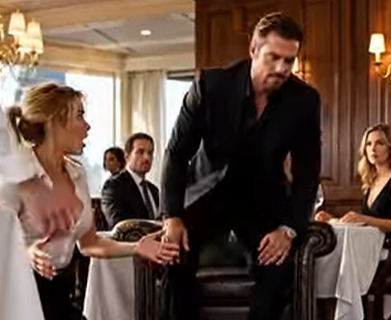
Then came the final indignity. The hospital door swung open without a knock, and Chloe, Connor’s sleek, ambitious assistant, stepped inside. She rested one manicured hand protectively over her stomach, wearing the triumphant, predatory grin of a woman who believed she had just won the ultimate corporate hostile takeover.
“Twelve weeks,” she had announced proudly, her voice dripping with rehearsed sweetness.
They had staged that entire moment for maximum devastation. They wanted me broken. They wanted me weeping hysterically into the coarse hospital pillows, begging a man who had checked out months ago to stay, clutching at coat tails and dignity alike. They wanted to bask in my absolute ruin before the IV line had even been pulled from my arm.
Instead, something inside me didn’t break. It froze. It hardened into a diamond-sharp clarity.
I didn’t yell. I didn’t throw things. I simply reached over to the bedside table, picked up the pen, and calmly signed the acknowledgment that I had received the divorce papers—and nothing more. I didn’t sign away my rights, I didn’t sign away my dignity, and I certainly didn’t give them the satisfaction of a single tear.
Connor never noticed the fine print. He was too intoxicated by his own delusion, too busy believing he had orchestrated the cleanest, most ruthless exit in modern history.
Three days later, while I was sitting alone in a quiet, sunlit room nursing my daughter and wondering how I was going to rebuild an entire life from the ashes, Connor’s announcement dropped across social media like a detonated bomb. A professionally staged photo of him and Chloe holding a pair of tiny blue baby shoes, captioned with sickening bravado about “new beginnings” and “the true heir.” His mother flooded every platform with blue balloons, tagging mutual friends, business associates, and distant relatives to ensure the humiliation was total, public, and inescapable.
The internet whispered. Sympathetic text messages poured in from people I hadn’t spoken to in years. Friends assumed I was cowering in a dark room somewhere, sobbing into a tub of ice cream, completely shattered by the betrayal.
Let them think what they wanted. I wasn’t hiding. I was waiting.
The turning point came on an ordinary Tuesday morning. The house was dead quiet except for the soft hum of the refrigerator and the gentle, milk-warm sounds of Brinley breathing against my collarbone. My phone buzzed on the coffee table with a routine email notification from the fertility clinic where Connor and I had spent two grueling, emotionally exhausting years trying to conceive before miracle or science finally intervened.
Usually, automated clinic emails are just billing statements or appointment reminders that get swiped away without a second thought. But something—call it maternal instinct, call it the quiet hum of a universe righting its wrongs—made me tap the notification and open the PDF attachment.
I scrolled past the header. I read the medical jargon once.
Then my breath caught. My hands started shaking so violently that I had to anchor my phone against the arm of the sofa to keep from dropping it.
I read the date again.
And slowly, terrifyingly, a smile crept across my face. It wasn’t a happy smile. It was the smile of a ghost stepping out of the shadows.
Connor hadn’t just betrayed me. He hadn’t just traded me in for a younger, flashier model like a depreciated luxury car. He had built his entire grand, arrogant, public new life on a biological impossibility so astronomical, so thoroughly documented, that he never in a million years imagined I would dig deep enough to uncover it.
Months blurred past in a relentless whirlwind of quiet preparation. While Connor was busy planning his lavish, high-society wedding to Chloe—flaunting her “miracle baby bump” to every golf buddy, investor, and socialite who would listen—I was quietly assembling a dossier. I spoke to family law attorneys who looked at the documents I brought them with eyes wide with disbelief. I secured certified copies, medical affidavits, and digital footprints that formed an unbreakable iron cage.
I didn’t want a messy legal battle that dragged out for years. I wanted theater. I wanted a reckoning so absolute, so public, and so profoundly devastating that Connor would never recover from it.
Which brings me to today.
The wedding venue looked like a set piece out of a glossy magazine—crystal chandeliers dripping from vaulted ceilings, cascading arrangements of white roses and eucalyptus, and an army of impeccably dressed guests sipping champagne while a string quartet played a melancholic classical arrangement. It was the social event of the season, a masterclass in performative perfection.
And I was crashing it.
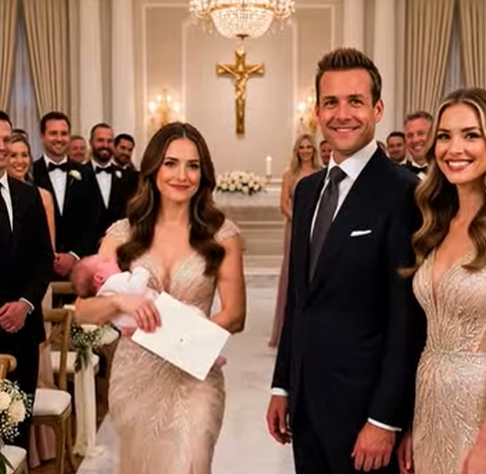
I didn’t sneak in through the service entrance or hide in the back. I walked right through the grand double doors of the ballroom, holding Brinley securely in one arm against my chest—dressed in a miniature ivory dress that matched my own tailored charcoal suit—and a single, heavy, cream-colored envelope in my other hand.
The moment the heavy oak doors clicked shut behind me, the ambient chatter in the room instantly died. The string quartet sputtered out on a discordant note. Heads snapped around in unison, a hundred pairs of eyes locking onto me with a mixture of shock, horror, and morbid fascination.
At the altar, standing beneath a massive floral arch, Connor froze mid-sentence, his wedding vows dying on his lips. Beside him, Chloe gasped, her hand instinctively flying to her dramatic, artfully draped pregnancy gown as if she had just seen a ghost walk through a wall.
In the front row, Connor’s mother shot up out of her velvet chair, her face contorting into a mask of pure, unadulterated fury.
“What on earth is she doing here?” she shrieked, her voice cutting through the stunned silence like a glass shard. “Security! Someone throw this pathetic lunatic out before she ruins everything!”
Nobody moved. The security guards standing by the doors looked at me, looked at the baby, and then looked at the cold, terrifying stillness in my posture, and wisely stayed put.
I didn’t yell. I didn’t cause a scene. I simply walked down the central aisle, my heels clicking rhythmically against the polished marble floor, each step echoing like a countdown in the cavernous room.
Connor stepped away from the altar, his face draining of all color until he looked like a corpse standing in a tuxedo. Sweat beaded instantly along his hairline. He looked down at Brinley in my arms, and then up at my face, his mouth opening and closing soundlessly like a fish out of water.
“Evelyn…” he choked out, his voice trembling in front of two hundred of his most important business associates, wealthy investors, and snobby relatives. “What is the meaning of this? You can’t just barge in here—”
“Quiet, Connor,” I said. My voice wasn’t raised. It didn’t shake. It was as cold and sharp as a scalpel.
I stopped three feet away from him, right at the edge of the altar stairs. I didn’t look at Chloe. I didn’t look at his mother. I kept my eyes locked entirely on the man who had tried to throw me away like yesterday’s trash.
Without breaking eye contact, I extended the heavy cream envelope toward him.
“You wanted an heir, Connor,” I whispered, loud enough for the first three rows of terrified guests to hear every syllable. “You wanted a son so badly that you blew up a marriage, humiliated me publicly, and traded your family for a shiny new accessory.”
Connor swallowed hard, his Adam’s apple bobbing violently. He didn’t reach for the envelope. He just stared at it as if it were ticking.
“Take it,” I commanded softly.
With shaking, hesitant fingers, Connor reached out and pulled the envelope from my hand. He tore the flap open, pulled out the folded medical records and legal depositions inside, and his eyes scanned the first page.
In less than five seconds, every trace of color vanished entirely from his face. His knees buckled slightly, and he had to catch himself against the edge of the altar table, his breath coming in ragged, shallow gasps.
“This… this isn’t possible,” he whispered, staring down at the paper as if it were written in an alien language. “Where did you… how did you—”
“You forgot one very important detail about our time at the fertility clinic, Connor,” I said, stepping just a fraction closer so only he and the horrified wedding party could hear the truth. “And trust me… that is only page one.”